
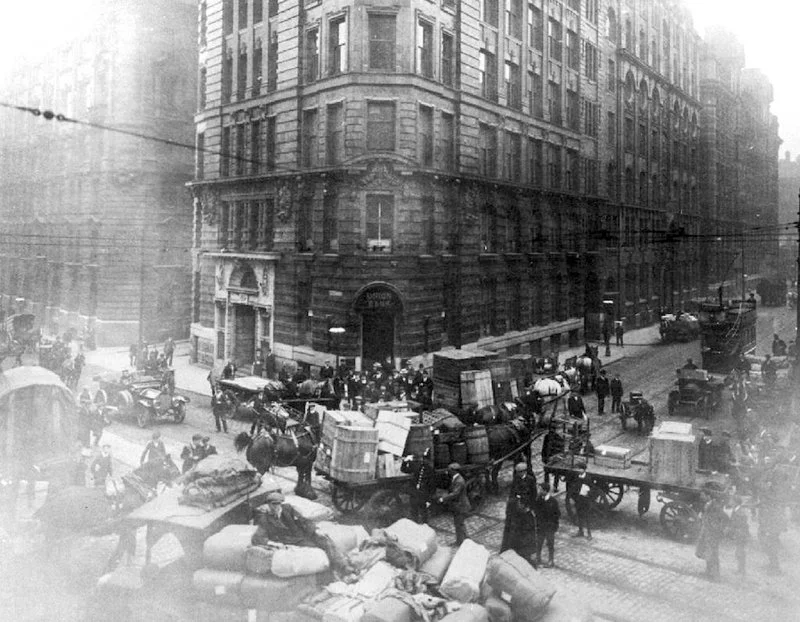
Cottonopolis and the Tame Valley
How Mossley became part of the world’s first industrial landscape
Long before the word “Cottonopolis” was coined, before Manchester became synonymous with textile production, and before Woodend Mill stood beside the canal and river, the Tame Valley was a place shaped by water, skill, and necessity.
The river ran through steep-sided valleys, its steady flow offering power long before steam and electricity. Small settlements grew along its banks, where families lived and worked close to the land. Cloth making was already part of life here — not yet industrial, but domestic. Handloom weavers worked from cottages, spinning and weaving wool and linen alongside agricultural labour.
This was slow work. Skilled work. Work that belonged to people and place.
But the valley was on the edge of transformation.
Water, Skill, and the First Mills
By the late eighteenth century, the forces of change were gathering. New technologies — spinning frames, water-powered machinery, and improved looms — made it possible to produce cloth on a scale never before imagined.
The River Tame became a source of mechanical power. Its energy could be harnessed to drive machines, allowing production to move from cottages into mills.
The first textile mills appeared along the valley, their presence altering both landscape and daily life. Communities grew around them. Families who had once worked independently became part of a shared industrial rhythm.
Mossley, positioned along the Tame and connected by developing transport routes, became one of the towns shaped by this change.
The valley itself became a working system — water powering machinery, people powering production, and mills anchoring communities.
The Arrival of Cotton
Cotton transformed everything.
Unlike wool, cotton could be spun into finer threads and woven into lighter, more versatile cloth. Demand grew rapidly, and the North West of England became the centre of its production.
Raw cotton travelled vast distances before reaching Mossley. It was carried across oceans, unloaded at Liverpool, and transported inland along canals that threaded through the valleys.
The Huddersfield Narrow Canal, completed in the early nineteenth century, brought Mossley into direct connection with this wider industrial network. Boats carried cotton inward and cloth outward, linking the Tame Valley to national and international markets.
What had once been a rural valley became part of a global system.
The Rise of Cottonopolis
Manchester became known as Cottonopolis — the heart of the cotton industry.
But Cottonopolis was not only a city. It was a region.
Its strength depended on surrounding towns like Mossley, where spinning, weaving, and finishing took place in mills built along rivers and canals. Each town played its part within a vast and interconnected industrial landscape.
Woodend Mill, established in the nineteenth century, became part of this network. Its weaving shed, designed to maximise light and efficiency, housed looms that transformed raw cotton into finished cloth.
The mill provided employment, stability, and identity. Generations of families worked within its walls. Skills were passed down. Communities formed around shared labour and shared experience.
The valley, once shaped primarily by water and agriculture, became shaped by industry.
Life in an Industrial Town
Industrialisation brought opportunity, but also demanded endurance.
Work in the mills required concentration, physical resilience, and learned skill. The sound of looms became part of everyday life. The rhythm of production structured time itself.
Mossley grew as people came to work in its mills. Streets, homes, and institutions developed alongside industry. The town’s identity became inseparable from textile production.
The landscape bore witness to this transformation. Mills rose beside waterways. Canals carried goods. Railways followed. The valley became an industrial corridor, linking Mossley to Manchester, Liverpool, and the wider world.
Yet even within this vast system, the work remained deeply human — carried out by individuals whose lives, families, and futures were shaped by the industry.
Decline and Silence
By the twentieth century, global economic changes began to reshape textile production.
Gradually, mills closed. Machinery fell silent. Buildings that had once been full of movement and sound stood empty.
The industry that had defined Mossley for generations receded.
But its presence never disappeared entirely.
It remained in the buildings, in the landscape, and in memory.
What Remains
Today, the weaving shed at Woodend Mill stands as a physical link to this history.
Its gritstone walls, saw-tooth roof, and position beside canal and river tell the story of a time when Mossley was part of the world’s first industrial society.
The building is not simply a relic. It is evidence.
Evidence of skill, adaptation, and collective effort.
Evidence of Mossley’s place within Cottonopolis — not as a distant satellite, but as an essential part of its fabric.
Renewal and Continuity
The restoration of the weaving shed is not about returning to the past. It is about carrying its meaning forward.
By preserving the building and sharing its story, Thread & Butter Collective is ensuring that Mossley’s role in the history of cotton is not forgotten.
The valley remains. The river still flows. The canal still connects places and people.
And the weaving shed, once silent, will become active again — not as a place of industrial production, but as a place of memory, learning, and creative renewal.
In this way, the story of Cottonopolis continues — here, in Mossley, where it always belonged.