
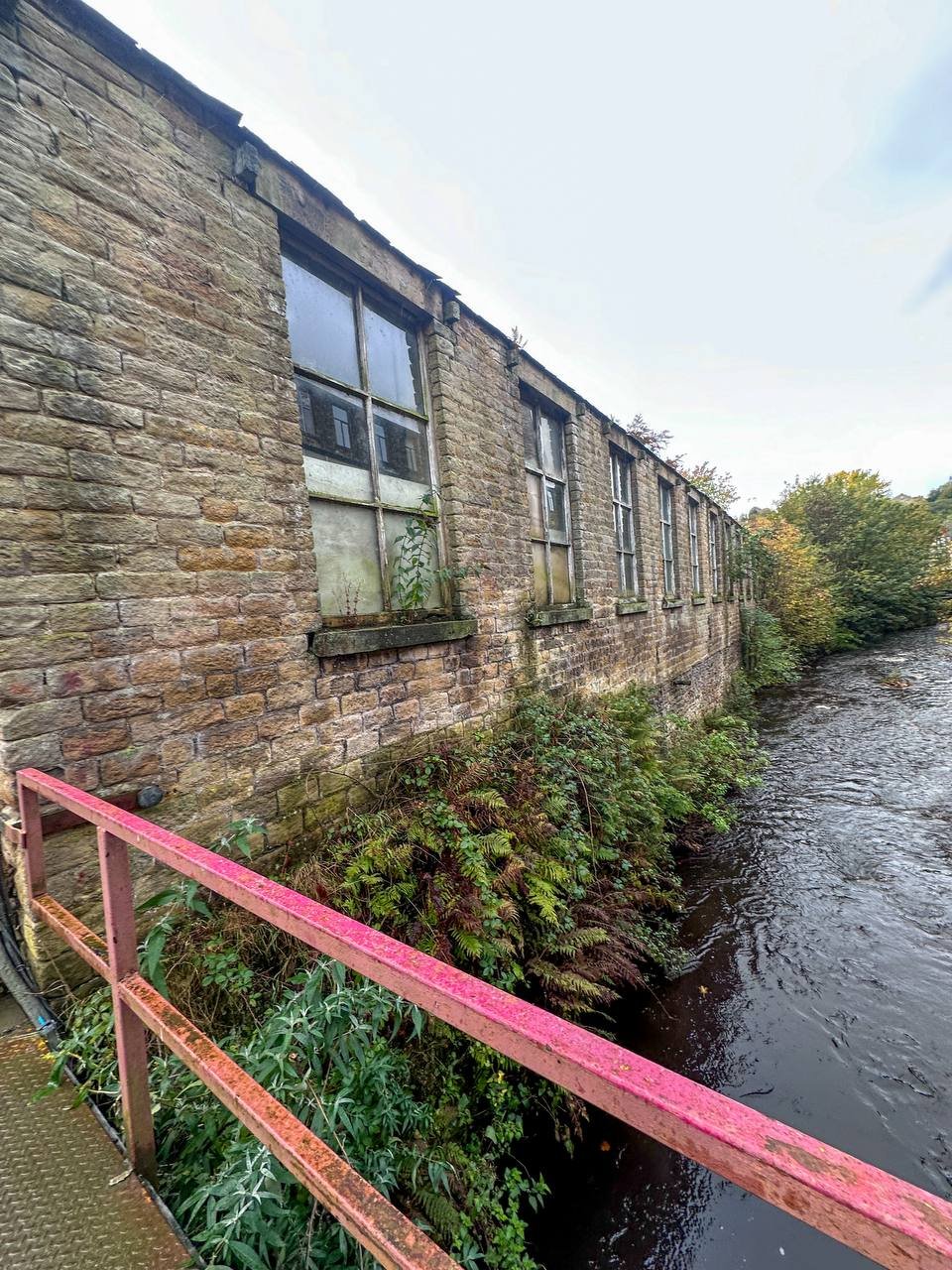
THE FABRIC OF THE SHED
Understanding the building, its materials, and its light
Before the stories of people, there was the building itself.
The weaving shed at Woodend Mill was designed with a singular purpose: to support the making of cloth. Every wall, every opening, every angle of its roof reflects the technical demands and human realities of textile production. It is not simply a container for history — it is an artefact in its own right.
This programme invites participants to look closely at the physical fabric of the shed and to understand how architecture, material, and engineering shaped the lives and work of those inside it.
Built from the Landscape
The shed was constructed using coursed and squared gritstone, quarried locally from the Tame Valley. These stones carry the geological memory of the landscape itself. Their durability allowed the building to endure generations of industrial use, weather, and change.
Participants will be invited to join guided site walks exploring the building’s exterior and interior structure. These sessions will introduce the principles behind traditional construction methods, including the use of lime mortar — a breathable material that allows historic buildings to move, settle, and release moisture naturally.
Understanding these materials is essential not only for appreciating the shed’s past, but also for ensuring its careful and appropriate restoration.
Through these sessions, participants will gain insight into how historic buildings survive — and why traditional methods remain vital today.
The Architecture of Light
Perhaps the most distinctive feature of the weaving shed is its saw-tooth roof, with its north-facing glazed sections known as Northern Lights.
This design was not aesthetic decoration. It was a functional response to the needs of weavers.
Natural light was essential for working with fine threads, identifying flaws, and maintaining consistent quality. The north-facing orientation provided steady, diffuse illumination without the harsh glare or shifting shadows caused by direct sunlight.
Participants will have the opportunity to explore the roof structure from within the shed, learning how its four-bay design maximised usable light across the entire working floor.
These sessions will reveal how engineering and human need were inseparable — and how the building itself became a tool in the production process.
Reading the Building as a Record
Every mark within the shed tells a story.
Subtle wear patterns on stone floors. Fixings embedded in beams. Variations in masonry. Each element offers clues to the building’s use, adaptation, and endurance.
Participants will be encouraged to observe the shed not simply as a space, but as a historical record — one that can be read and understood.
By learning to recognise these details, visitors gain a deeper connection to the people who worked here and the physical realities of their labour.
Restoration as Continuity
As the weaving shed undergoes careful conservation and repair, these sessions will offer rare insight into the restoration process itself.
Participants will see traditional materials and techniques being used not to recreate the past, but to extend its life responsibly into the future.
This programme helps ensure that restoration is not something done behind closed doors, but something understood, shared, and valued by the community.
Why This Matters
Buildings like the Woodend Mill weaving shed are increasingly rare.
When they are lost, it is not only stone and timber that disappear, but knowledge — knowledge of how they were made, how they functioned, and what they meant.
By learning to understand the fabric of the shed, participants become part of its continued story.
They help ensure that its meaning is not forgotten, and that its presence remains active within the life of Mossley.
Who Can Take Part
These sessions are open to everyone.
No prior knowledge of architecture, construction, or heritage is required. Only curiosity and a willingness to look closely.
Whether you are a lifelong resident, a maker, a student, or simply someone interested in the history of the place you live, you are welcome.
When
These activities will take place throughout the restoration period. Dates will be announced as the project progresses.